How to budget for a wedding
Most of a wedding's cost rises and falls with one number: how many people you invite. Start there, then split the rest.
Enter your total budget to see a typical breakdown across every wedding category.
A wedding budget is hard to pin down because most advice is a list of percentages: 40% here, 10% there, a line for everything. Those percentages help, but they skip the one fact that controls your total. Before you divide anything, look at your guest list. That single number shapes more of the bill than any other choice you will make.
Why guest count drives your wedding budget
Most wedding costs are charged per head. The venue is sized by how many people it must seat, and catering, drinks, tableware, place settings, favours and even the cake all scale with the guest count. On typical breakdowns those per-person items work out at roughly half the total, which is why trimming the list is such a strong lever: drop 20 guests and you are not saving on a single line, you reduce the venue, the catering and the bar together.
So begin with two numbers rather than a theme or a dress: the total you can realistically spend, and the number of people you want there. Divide the first by the second for a rough per-guest figure, then use it to sanity-check every venue and caterer. If a quote sails past it, the usual fix is fewer guests, though a cheaper venue, an off-peak date or a lighter bar can get you there too, and family or cultural expectations do not always allow a shorter list.
A wedding budget breakdown that works at any total
Once you know your total and your headcount, a breakdown turns one large figure into a set of manageable envelopes. The ranges below are a commonly cited starting point, close to the percentage guides published by The Knot and Vogue, and they work in any currency and at any budget size because they are proportions, not fixed prices:
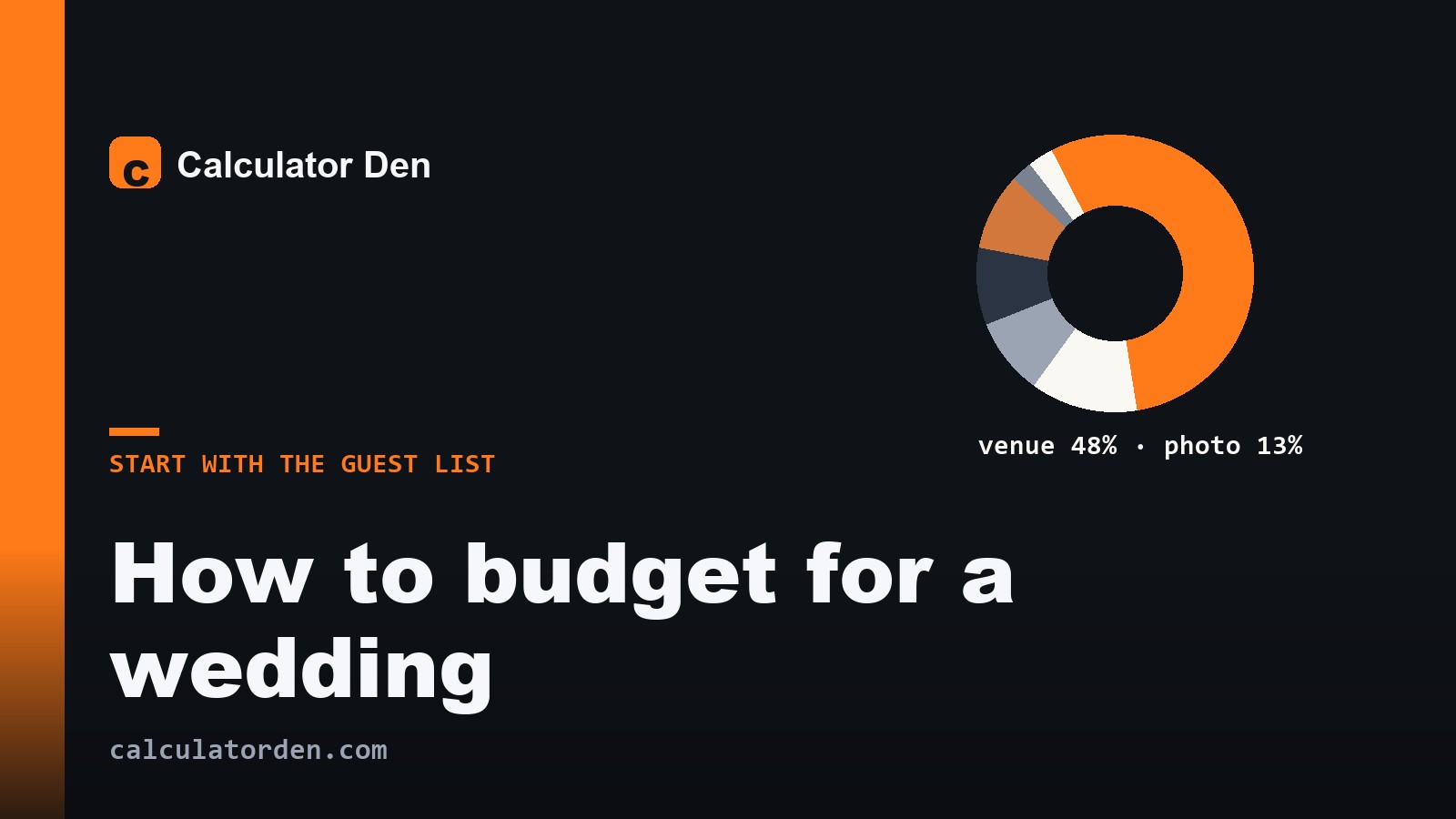
Venue and catering (food and drink): 45 to 50%. The largest block, and the part tied most closely to guest count.
Photography and video: 10 to 15%. The main thing you keep afterwards.
Attire and beauty: 8 to 10%. Outfits, alterations, hair and makeup.
Flowers and decor: 8 to 10%. Highly variable, and easy to scale up or down.
Music and entertainment: 8 to 10%. A band costs more than a DJ or a playlist.
Stationery and extras: 2 to 3%. Invitations, signage, favours.
Rings: around 3%, if they come from the wedding budget rather than separately.
Buffer: 5 to 10%, explained below.
These are starting envelopes, not targets to hit at once. The ranges are not meant to be maxed together: the low ends add to about 89% and the high ends to about 111%, so spending at the top of every line would overshoot. If one category matters more to you, raise it and take the difference out of another so the whole still comes to 100. And if the rings sit outside the budget, drop that line and spread its share across the rest. This is the same envelope thinking behind any spending plan, like the 50/30/20 budget rule for everyday money.
A worked example
Say your total is 100,000 (in whatever your currency is) and you are inviting 80 guests. That is 1,250 per guest to measure venue-and-catering quotes against. Applying the midpoints of the ranges gives roughly: venue and catering 47,500; photography and video 12,500; attire and beauty 9,000; flowers and decor 9,000; music 9,000; stationery and extras 2,500; rings 3,000; and a buffer of 7,500. Change the total to 40,000 and every figure scales down by the same proportion, which is the whole point of working in percentages: the plan holds whether the number is large or small.
Hidden wedding costs almost everyone forgets
Budgets tend to break not on the big obvious lines but on the small ones nobody wrote down. Account for these from the start:
Tax and service charges. Many venues and caterers quote before tax and before a service charge, which in some markets adds 15 to 25% to the catering bill. Always ask whether a quote is the final figure.
Gratuities, where tipping is customary. Tips for servers, drivers and some vendors are often expected on top, but norms vary widely by country and in many places tipping is not expected at all. Our guide on how to tip covers what is normal where it applies.
Vendor meals. Photographers, the band and the planner usually need feeding, and caterers charge for those plates.
Overtime. Run the party past the booked finish and the venue, band and photographer may all charge extra by the hour.
Alterations. A dress or suit almost always needs fitting, and that cost sits outside the purchase price.
Deposits and timing. Vendors usually want deposits months ahead, not on the day, so plan for money leaving early.
Postage, trials and travel. Invitations, a hair-and-makeup trial and getting everyone to the venue all add up.
Where to cut without slashing the guest list
If the guest list cannot move, the cost still can. An off-peak date or a weekday often cuts the venue price sharply. A venue that lets you bring your own drinks, or one that already includes tables and chairs, removes a whole rental line. Swapping a live band for a DJ, choosing seasonal local flowers, sending digital invitations and keeping the favours simple each trim a category without touching the headcount. Because the big envelopes are the venue, catering and photography, that is where a single decision saves the most.
How to build a buffer into your wedding budget
This is why the 5 to 10% buffer is strongly recommended. Something usually comes in higher than planned or gets added late, and a buffer stops one surprise from forcing you to raid another category. If you never touch it, it becomes a head start on the honeymoon. Set it aside at the beginning rather than hoping the numbers leave room at the end, because they seldom do.
Saving for a wedding: turn the total into a monthly target
If the day is a way off, convert the total into a monthly savings target: divide what you need by the months until the wedding. Working backwards from the date keeps the goal concrete and warns you early if the timeline or the total needs to flex. Remember that deposits fall due well before the day, so the money has to be ready in stages rather than all at the end. Our savings goal calculator does that sum for you.
The bottom line
Start with your total and your guest count, split the rest into percentage envelopes you can adjust to your priorities, list the hidden costs before they ambush you, and protect a buffer from day one. Put your total and headcount into our wedding budget calculator to see each category as a real figure, then shift the split until it matches what matters most to you. These are rough planning ranges rather than financial advice, and real prices vary a lot by country, season and supplier.
Frequently asked questions
How much of a wedding budget goes to the venue and food?
Usually 45 to 50%, by far the largest block. It is also the part tied most closely to your guest count, since the venue size, catering, drinks and tableware all scale with how many people attend. Cutting the guest list is the most effective way to bring this figure down.
What is a simple wedding budget breakdown?
A common split is venue and catering 45 to 50%, photography and video 10 to 15%, attire and beauty 8 to 10%, flowers and decor 8 to 10%, music 8 to 10%, stationery and extras 2 to 3%, rings about 3%, and a 5 to 10% buffer. Adjust the proportions to your priorities so long as they still total 100%.
What wedding costs do people forget to budget for?
The common surprises are tax and service charges on catering, gratuities for vendors, meals for your photographer and band, overtime if the party runs late, dress or suit alterations, and smaller items like postage and a hair-and-makeup trial. Listing these upfront keeps them from breaking the budget.
Why does the guest count matter so much?
Because most wedding costs are per person. The venue, catering, drinks, place settings and favours all rise with the number of guests, and together they are about half the budget or more. Reducing the guest list saves money across several categories at once rather than just one.
How big should my wedding budget buffer be?
Set aside 5 to 10% of the total for surprises and late additions. Something almost always costs more than planned, and a dedicated buffer stops one overrun from forcing cuts elsewhere. Reserve it at the start rather than hoping money is left over at the end.