What is a good credit score?
A good score depends on where you live and which scale is used. Here are the ranges by country, what actually moves your number, and the myths to ignore.
Enter the loan amount, interest rate and term to see your monthly repayment, the total you will pay back, and the total interest.
A credit score is a number lenders use to guess how likely you are to pay back what you borrow, and a higher one unlocks cheaper loans, bigger mortgages and better credit cards. But "what counts as good" is not one universal number: it depends on which country you are in and which company did the scoring. This guide gives the ranges by country, explains what actually moves your score, and clears up the myths, so you know where you stand wherever you live.
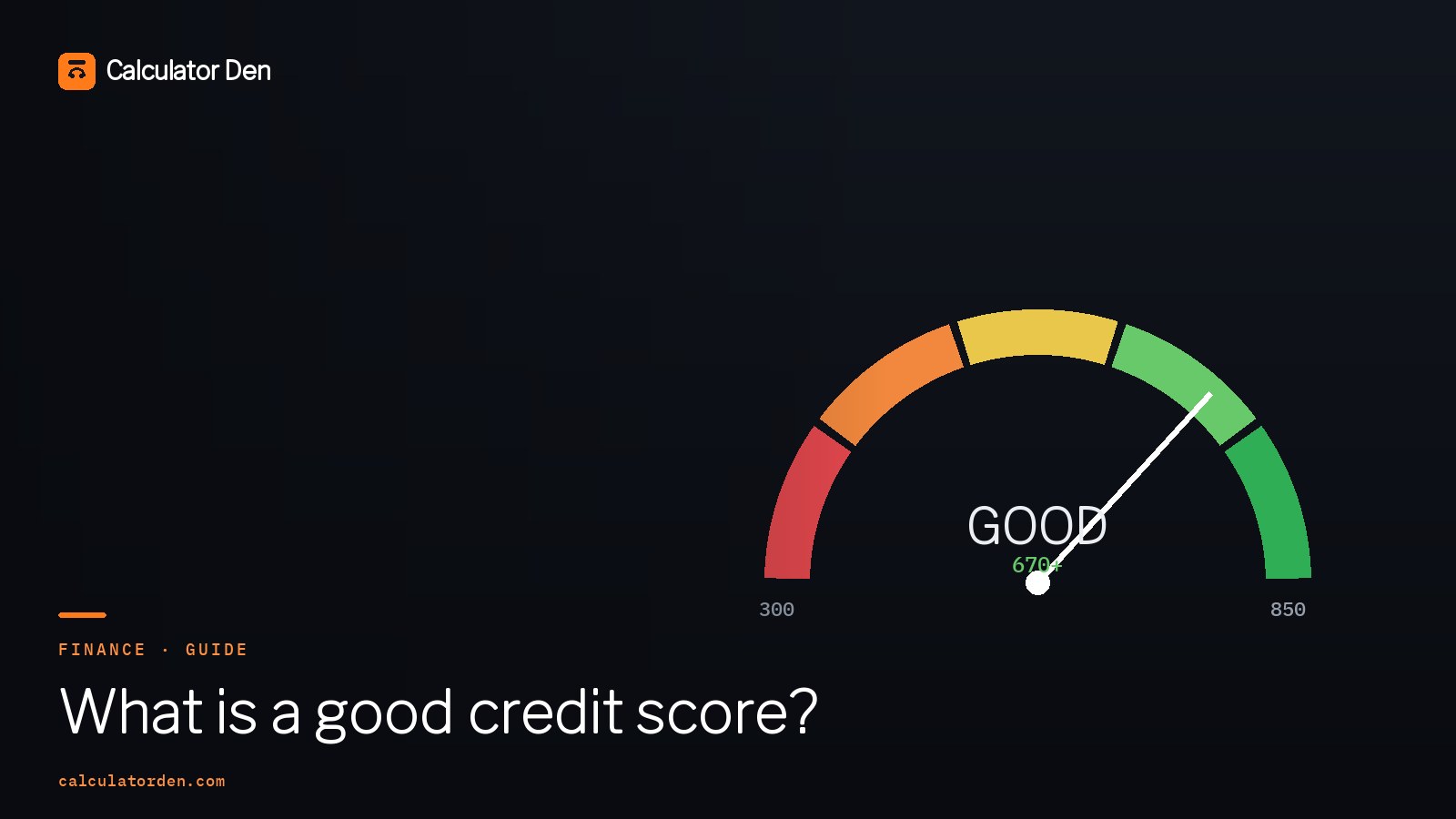
In short: on the most common US scale (300 to 850), a score of 670 or above is good, 740 and up is very good, and 800 and up is excellent. Other countries use different scales, so the number that is good in the US is not the number that is good in the UK or India. What a higher score buys you is a lower interest rate, which a loan calculator turns into real money on your repayments.
What is a good credit score in the US?
Most US lenders use a FICO or VantageScore, both running from 300 to 850. The widely used FICO bands, as published by Experian, are:
| Score (FICO) | Rating |
|---|---|
| 800 to 850 | Exceptional |
| 740 to 799 | Very good |
| 670 to 739 | Good |
| 580 to 669 | Fair |
| 300 to 579 | Poor |
So 670 is the line most lenders treat as "good", and past about 740 you tend to qualify for the best rates. VantageScore uses the same 300 to 850 range but slightly different band cutoffs, with "good" starting around 661, so the same number can fall in a different band depending on the model. Lenders also tend to use specific, often older, FICO versions for mortgages and car loans, which is why a free app score may not exactly match the one a lender sees.
A good credit score by country
This is where people get caught out: the scales are different almost everywhere, so a "good" number in one country is meaningless in another. These are the common ranges, but bureaus differ even within a country, so treat them as a guide and check your own report.
| Country | Common scale | Roughly "good" |
|---|---|---|
| United States | 300 to 850 | 670 and above |
| United Kingdom | No single score; each agency differs (for example Experian 0 to 999) | Upper end of each agency's scale |
| Canada | 300 to 900 | About 660 and above |
| Australia | Varies by agency (for example Equifax 0 to 1200) | Upper part of the scale |
| India | CIBIL 300 to 900 | About 750 and above |
| South Africa | Bureaus use roughly 0 to 999 | Upper part of the scale |
The one rule that travels everywhere: a higher number is better, and being near the top of whatever scale your country uses is what gets you the best interest rates.
What credit score do you need to buy a house or a car?
These are the two questions people ask most, and the honest answer is that the minimum to be approved is lower than the score that gets you a good rate. In the US, many conventional mortgages look for a score of around 620 as a starting point, government-backed FHA loans accept lower in tiers, and the best rates go to scores in the 740s and above. Car loans are usually tiered too: you can often be approved with a fair score, but a higher one drops the interest rate you are offered. Outside the US, the lender leans more on your bureau band, your income and your deposit than on a single cut-off number, and our guide on how much house you can afford covers the rest of the picture.
The reason the exact number matters is the rate. On a long loan, even a one percentage point difference adds up to a large sum over the full term. Put your own figures into the loan calculator or mortgage calculator to see what moving up a band could save you. This is general information, not financial advice.
What if your country does not use a credit score?
Some countries have no widely published consumer credit score, or lenders rely mainly on bureau reports rather than a single number. South Africa is an exception, with proper bureau scores, while in Botswana and some neighbours there may be no universal FICO-style number, so it is worth checking with your bank or the local bureau what, if any, score is shown about you. Either way, lenders assess you from credit bureau reports (check which bureaus, such as TransUnion, operate in your country), your banking history, your income and any existing loans. The principle is the same even without a number: a clean record of borrowing and repaying on time is what makes a bank say yes and offer a lower rate. You can usually request your report from the local credit bureau.
What actually moves your credit score
Wherever you are, the same handful of factors drive the number, roughly in this order of importance:
- Payment history. Paying on time, every time, is the single biggest factor. One missed payment can dent a good score sharply.
- How much credit you use. Using a large share of your available limit (your credit utilisation) looks risky. A common guide is to keep it below about 30 percent.
- Length of history. Older accounts help, which is why closing your oldest card can backfire.
- Credit mix. A sensible mix of credit types, handled well, can help a little.
- New applications. Several applications in a short time each leave a mark and can look like you are desperate for credit.
Notice what is not on the list: your salary, your savings and your age do not directly set your score. It is about how you handle borrowing, not how much you earn.
Common credit score myths
| Myth | Reality |
|---|---|
| Checking your own score hurts it | No. Checking your own report is a soft check and does not lower your score |
| You need debt to have a good score | You need a history of using credit responsibly, not ongoing debt |
| Closing old cards helps | It often hurts, by shortening your history and raising your utilisation |
| Your income is part of your score | Income is not in the score itself, though lenders look at it separately |
| One score fits every lender | Lenders use different bureaus and models, so your number varies by source |
Why a good score is worth real money
A better score is not about bragging rights, it is about the interest rate you are offered. On a mortgage or a car loan, even a small difference in rate adds up to thousands over the life of the loan. That is the practical reason to care: move from a fair score to a good one and the same loan costs you less every month. See what a rate change does to your repayments with our loan calculator and mortgage calculator, and check whether a new repayment fits your budget with the debt-to-income calculator.
How to improve a credit score
The fixes are boring and they work. Pay every bill on time, set up automatic minimum payments so you never miss one, and bring your card balances down below about a third of the limit. If high balances are the real problem, our guide on how to pay off debt faster helps you bring them down. Keep your oldest accounts open, space out new applications, and check your report for errors, since a mistake on your file can drag your score down through no fault of yours. Improvement takes months, not days, but the direction is what matters. This is general information, not financial advice, so for your own situation check your credit report and, if in doubt, speak to a qualified adviser.
Frequently asked questions
What is a good credit score?
On the US 300 to 850 scale, 670 and above is good, 740 and up is very good, and 800 and up is excellent. Other countries use different scales, so compare your number to the range your own country and bureau use.
What is a good credit score in the UK?
The UK has no single score. Each agency uses its own scale, for example Experian runs 0 to 999, Equifax 0 to 1000 and TransUnion 0 to 710, so "good" means being in the upper band of whichever agency a lender checks.
What is a good credit score in Canada?
Canadian scores run from 300 to 900, and roughly 660 and above is treated as good, with 725 and up considered very good. Check your own report with Equifax or TransUnion Canada, as lenders use their own thresholds.
What is a good credit score in India?
The common CIBIL score runs from 300 to 900, and about 750 and above is widely seen as good and improves your odds of approval at a better rate. Other bureaus such as Experian and CRIF operate in India too, each with its own scale.
What is a good credit score in South Africa or Australia?
South African bureaus use a scale of roughly 0 to 999, and in Australia agencies like Equifax run 0 to 1200, so "good" means the upper part of whichever scale applies. Check your own bureau report, since the exact bands differ by agency.
Does checking my credit score lower it?
No. Checking your own score or report is a soft inquiry and does not affect your score. Only a hard inquiry, when a lender checks your file for an application, can nudge it down slightly and only for a while.
What is the most important factor in a credit score?
Payment history. Paying your bills on time, every time, matters more than anything else, which is why a single missed payment can lower a good score noticeably.
How long does it take to improve a credit score?
Usually months, not days. On-time payments and lower card balances start to help within a few billing cycles, but rebuilding after missed payments or defaults takes longer. Consistency over time is what moves the number.
Do all countries have credit scores?
No. Many countries, including much of Africa, do not use a single consumer credit score. Lenders there rely on credit bureau reports, your banking history and income instead, but the same habit of borrowing and repaying on time still decides whether you are approved.