Roman numerals explained
They look cryptic, but Roman numerals run on just seven letters and two simple rules. Here is how to read and write any of them, with a chart and worked examples.
Turn any whole number from 1 to 3999 into Roman numerals.
Roman numerals turn up far more often than you would expect: the year at the end of a film, the chapter headings in a book, the face of a fancy clock, the number after a king's name, even the Super Bowl. They look cryptic at first, but the whole system runs on just seven letters and two simple rules. Learn those and you can read or write any of them.
In short: Roman numerals use seven letters, I = 1, V = 5, X = 10, L = 50, C = 100, D = 500 and M = 1000. You read them left to right, adding as you go, except when a smaller letter sits before a larger one, which means subtract. So IV is 4 and MMXXVI is 2026. A free Roman numeral converter does it both ways instantly.
The seven symbols
Everything is built from these seven letters. There is no symbol for zero, which is one of the big differences from the numbers we use every day.
| Symbol | Value |
|---|---|
| I | 1 |
| V | 5 |
| X | 10 |
| L | 50 |
| C | 100 |
| D | 500 |
| M | 1000 |
The two rules that run everything
Rule 1: add when values stay the same or get smaller. Line the letters up from biggest to smallest and add them. VI is 5 + 1 = 6. XVII is 10 + 5 + 1 + 1 = 17. MDCLXVI is 1000 + 500 + 100 + 50 + 10 + 5 + 1 = 1666.
Rule 2: subtract when a smaller value comes before a larger one. To avoid writing four of the same letter in a row, a smaller symbol goes in front of a bigger one to mean "one less". IV is 5 minus 1 = 4, and IX is 10 minus 1 = 9. Only six subtractive pairs are allowed:
| Pair | Value |
|---|---|
| IV | 4 |
| IX | 9 |
| XL | 40 |
| XC | 90 |
| CD | 400 |
| CM | 900 |
How to read Roman numerals
Work left to right. If a letter is worth the same or more than the one after it, add it. If it is worth less than the one after it, subtract it. Take MCMXCIV: M is 1000, then CM is 900, then XC is 90, then IV is 4. Add them up, 1000 + 900 + 90 + 4 = 1994. It looks intimidating until you chunk it into those pieces.
How to write numbers in Roman numerals
The trick is to break the number apart by place value, convert each piece, then join them up. Write 2026:
- 2000 = MM
- 20 = XX
- 6 = VI
Join them: MMXXVI. A trickier one, 49, is not IL. You build it as 40 (XL) plus 9 (IX) = XLIX. And 94 is XC (90) plus IV (4) = XCIV. Always break by place value, largest first, and use the subtractive pairs for the fours and nines.
Roman numerals chart: 1 to 1000
A full reference you can scan. Here are the Roman numerals from 1 to 100, then the tens and hundreds up to 1000. You can check any number up to 3999 with the free Roman numeral converter.
Roman numerals 1 to 100
| # | Roman | # | Roman | # | Roman | # | Roman | # | Roman |
|---|---|---|---|---|---|---|---|---|---|
| 1 | I | 21 | XXI | 41 | XLI | 61 | LXI | 81 | LXXXI |
| 2 | II | 22 | XXII | 42 | XLII | 62 | LXII | 82 | LXXXII |
| 3 | III | 23 | XXIII | 43 | XLIII | 63 | LXIII | 83 | LXXXIII |
| 4 | IV | 24 | XXIV | 44 | XLIV | 64 | LXIV | 84 | LXXXIV |
| 5 | V | 25 | XXV | 45 | XLV | 65 | LXV | 85 | LXXXV |
| 6 | VI | 26 | XXVI | 46 | XLVI | 66 | LXVI | 86 | LXXXVI |
| 7 | VII | 27 | XXVII | 47 | XLVII | 67 | LXVII | 87 | LXXXVII |
| 8 | VIII | 28 | XXVIII | 48 | XLVIII | 68 | LXVIII | 88 | LXXXVIII |
| 9 | IX | 29 | XXIX | 49 | XLIX | 69 | LXIX | 89 | LXXXIX |
| 10 | X | 30 | XXX | 50 | L | 70 | LXX | 90 | XC |
| 11 | XI | 31 | XXXI | 51 | LI | 71 | LXXI | 91 | XCI |
| 12 | XII | 32 | XXXII | 52 | LII | 72 | LXXII | 92 | XCII |
| 13 | XIII | 33 | XXXIII | 53 | LIII | 73 | LXXIII | 93 | XCIII |
| 14 | XIV | 34 | XXXIV | 54 | LIV | 74 | LXXIV | 94 | XCIV |
| 15 | XV | 35 | XXXV | 55 | LV | 75 | LXXV | 95 | XCV |
| 16 | XVI | 36 | XXXVI | 56 | LVI | 76 | LXXVI | 96 | XCVI |
| 17 | XVII | 37 | XXXVII | 57 | LVII | 77 | LXXVII | 97 | XCVII |
| 18 | XVIII | 38 | XXXVIII | 58 | LVIII | 78 | LXXVIII | 98 | XCVIII |
| 19 | XIX | 39 | XXXIX | 59 | LIX | 79 | LXXIX | 99 | XCIX |
| 20 | XX | 40 | XL | 60 | LX | 80 | LXXX | 100 | C |
Tens and hundreds
| Number | Roman | Number | Roman |
|---|---|---|---|
| 10 | X | 100 | C |
| 20 | XX | 200 | CC |
| 30 | XXX | 300 | CCC |
| 40 | XL | 400 | CD |
| 50 | L | 500 | D |
| 60 | LX | 600 | DC |
| 70 | LXX | 700 | DCC |
| 80 | LXXX | 800 | DCCC |
| 90 | XC | 900 | CM |
| 100 | C | 1000 | M |
Some years for reference: 2024 = MMXXIV, 2025 = MMXXV, 2026 = MMXXVI.
Big numbers, and why there is no zero
There is no symbol for zero because the system combines fixed values rather than using place-value columns the way our digits do. When the Romans needed to say nothing at all, they used the Latin word "nulla", not a numeral. The system also runs out of room fairly quickly. With the standard letters the largest number you can write cleanly is 3999 (MMMCMXCIX), since you do not repeat M more than three times.
For larger numbers the Romans drew a bar, called a vinculum, over a letter to multiply it by 1000. So a V with a bar means 5000, an X with a bar means 10,000, and an M with a bar means 1,000,000. You rarely need this today, and most tools, including our converter, stop at 3999. For the history and for help reading numerals in old documents, the UK National Archives has a clear primer.
Common mistakes to avoid
These are the slips people actually make. If a numeral ever looks wrong, it is usually one of these.
| Wrong | Right | Why |
|---|---|---|
| IIII (for 4) | IV | Use the subtractive pair, not four letters in a row |
| IC (for 99) | XCIX | You can only subtract from the next one or two sizes up |
| XXXX (for 40) | XL | A letter never repeats four times |
| VX (for 5) | V | V, L and D are never used to subtract |
| IIX (for 8) | VIII | Build from the largest value down, 5 then 3 |
- Writing out of order. Apart from the six subtractive pairs, letters always run strictly largest to smallest.
- Doubling V, L or D. These never repeat, because two of them would equal the next letter up (VV is just X).
Why clocks show IIII instead of IV
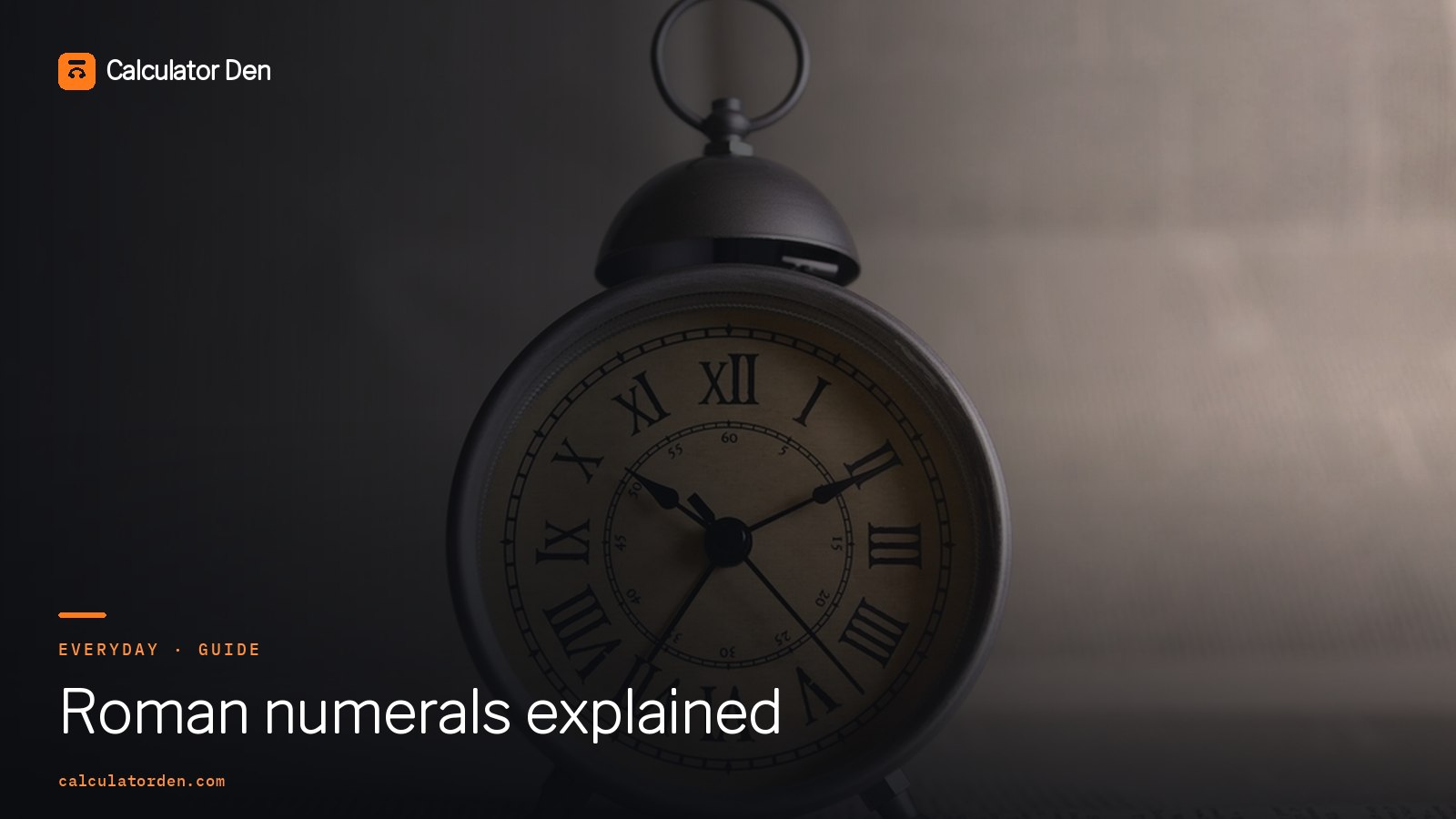
Look at a traditional clock face and the 4 is almost always IIII, not the IV you just learned. This is a genuine tradition rather than a mistake, and nobody is completely sure why it started. The two most common explanations are visual balance, since the heavy IIII sits opposite the heavy VIII and looks more even than a thin IV would, and an old reluctance to begin a number with IV because those letters start the Latin name of the god Jupiter (IVPITER). Whatever the real reason, clockmakers have used IIII for centuries, so treat the dial as the one place IIII is correct.
Where you will actually see them
Once you can read them, you will spot Roman numerals everywhere: copyright years at the end of films and TV shows (a 2026 release shows MMXXVI), Super Bowls and Olympic Games (Super Bowl LX is the 60th), the names of monarchs and popes (Elizabeth II, Louis XIV is the fourteenth), chapter and volume numbers in books, the hours on classic clock faces, and dates carved on buildings. Converting a year is the most common real task, and the Roman numeral converter handles it in a click, both ways.
Roman numerals questions
What is 2026 in Roman numerals?
2026 is MMXXVI: MM for 2000, XX for 20 and VI for 6.
Why is there no zero in Roman numerals?
The system combines fixed letter values instead of using place-value columns, so it never needed a zero. When the Romans meant nothing, they wrote the Latin word "nulla".
What is the largest Roman numeral?
With the standard letters it is 3999, written MMMCMXCIX. A bar over a letter multiplies it by 1000, which lets you go higher, but that notation is rarely used now.
Why do clocks use IIII instead of IV?
It is a long-standing tradition, usually explained by visual balance with the VIII across the dial, or by an old reluctance to use IV. The clock face is the one accepted place where IIII beats IV.
Is 99 written IC?
No. 99 is XCIX, which is 90 (XC) plus 9 (IX). You can only subtract from the next one or two sizes up, so IC is not valid.
What are the Roman numerals for 1 to 10?
I, II, III, IV, V, VI, VII, VIII, IX, X.