How to simplify a fraction
Simplifying a fraction means writing it with smaller numbers without changing its value. One factor does it in a single step.
Add, subtract, multiply or divide two fractions, simplified automatically.
Simplifying a fraction, also called reducing it, means rewriting it with smaller numbers while keeping its value exactly the same. 2/4 and 1/2 are the same amount; 1/2 is just the tidy version. Simplest form is easier to read, compare and work with, and it is usually what a teacher wants as the final answer. The whole job comes down to one idea: divide the top and bottom by the same number.
What "simplest form" means
A fraction has a top number (the numerator) and a bottom number (the denominator). It is in its simplest form when the only whole number that divides into both of them is 1, so there is nothing left to cancel. 1/2 is simplest because nothing but 1 divides into both 1 and 2. 2/4 is not, because 2 divides into both. Simplifying is the process of getting from the second kind to the first.
The reason it works without changing the value is that you divide the top and the bottom by the same number. Dividing both parts of a fraction by the same amount is like scaling a recipe down: the proportions, and so the value, stay identical.
The GCF method (one step)
The fastest way to simplify is to divide the top and bottom by their greatest common factor, the largest whole number that goes into both. This reaches simplest form in a single step:
1. Find the greatest common factor (GCF) of the numerator and denominator.
2. Divide both by it.
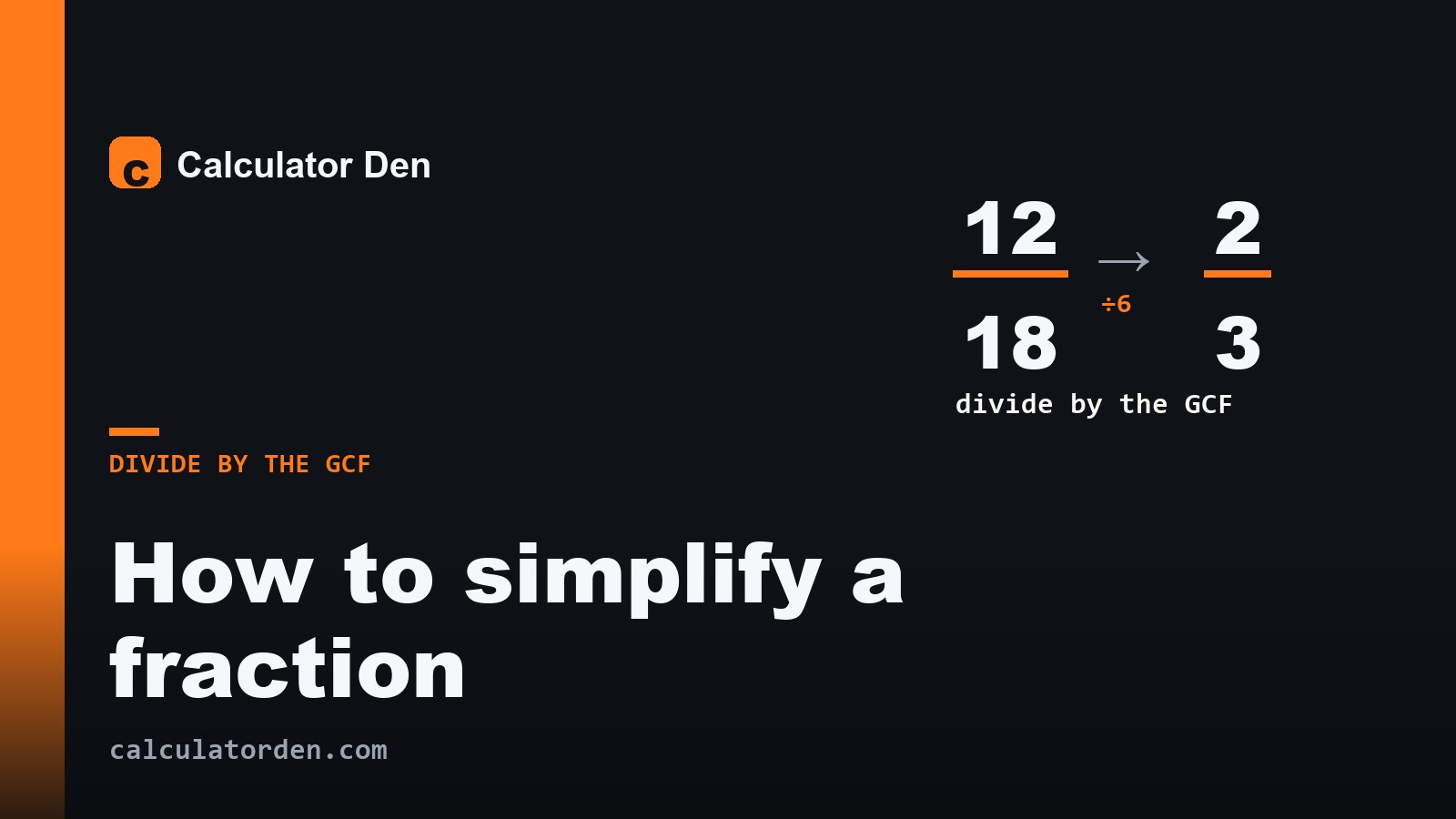
Take 12/18. The factors of 12 are 1, 2, 3, 4, 6, 12; the factors of 18 are 1, 2, 3, 6, 9, 18. The largest they share is 6, so divide both by 6: 12 ÷ 6 = 2 and 18 ÷ 6 = 3, giving 2/3. Check: nothing but 1 divides into both 2 and 3, so 2/3 is simplest. Done in one move.
The shortcut: keep dividing
If spotting the GCF is hard, you do not need it. Just divide the top and bottom by any common factor you can see, and repeat until nothing divides them both. Take 24/36: both are even, so halve them to 12/18; still even, halve again to 6/9; now 3 divides both, so divide by 3 to get 2/3. You reach the same answer, just in more steps. Starting with small, obvious factors like 2, 3 and 5 makes this easy to do in your head.
Mixed numbers and improper fractions
Two quick cases come up a lot. An improper fraction, where the top is bigger than the bottom, like 18/12, simplifies the same way (divide by the GCF, 6, to get 3/2) and can then be written as the mixed number one and a half (1 1/2) if you prefer. A mixed number like 2 4/8 is simplified by reducing just its fraction part: 4/8 becomes 1/2, so the answer is 2 1/2. The whole-number part is left alone.
Finding the GCF of bigger numbers
With small numbers you can spot the greatest common factor by eye, but for larger ones, prime factors make it reliable. Break each number into the primes that multiply to make it, then multiply the primes they share. Take 36/48. 36 is 2 × 2 × 3 × 3, and 48 is 2 × 2 × 2 × 2 × 3. They share two 2s and one 3, so the GCF is 2 × 2 × 3 = 12. Divide both by 12: 36 ÷ 12 = 3 and 48 ÷ 12 = 4, giving 3/4. This method never misses a factor, which the by-eye approach sometimes does.
A check, and the most common slip
Always finish by checking that the top and bottom share no factor but 1. If they still do, you did not divide by the full GCF and can simplify again: dividing 24/36 by 2 gives 12/18, which is smaller but not yet simplest, because 6 still divides both. Stopping too early is the most common mistake. The repeated-dividing method is safe here precisely because you keep going until nothing divides both numbers. It also works in reverse: multiplying the top and bottom by the same number gives an equivalent fraction with bigger numbers, which is how you put two fractions over a common denominator before adding them.
When a fraction is already simplest
Not every fraction can be reduced. If the top and bottom share no factor but 1 they are called coprime, and the fraction is already in simplest form: 7/9 cannot be reduced, because the factors of 7 are only 1 and 7, and 7 does not divide 9. A quick way to see where to start is the divisibility tests: if both numbers are even you can divide by 2; if both end in 0 or 5 you can divide by 5; and if the digits of each add up to a multiple of 3 you can divide by 3. One special case: when the bottom divides exactly into the top, the fraction becomes a whole number or a simple one, so 6/6 is 1 and 5/10 is 1/2.
When you need simplest form
Simplest form matters most in three places: as the final answer a teacher marks, when you compare fractions (it is far easier to see that 2/3 is bigger than 3/5 once both are tidy), and when you add or subtract fractions, where simplifying keeps the numbers small. It is rarely wrong to leave a fraction unsimplified, but it is almost always clearer to reduce it, which is why "write your answer in simplest form" is such a common instruction.
How it connects to ratios and percentages
Simplifying a fraction is the same move as simplifying a ratio: 12/18 and the ratio 12:18 both reduce by their GCF of 6 to 2/3 and 2:3. (A ratio compares one part to another, while a fraction is a part of a whole, but the reducing step is identical.) If you work with ratios, our guide on how to calculate a ratio uses exactly this step. And because a fraction is just a part of a whole, you can turn any simplified fraction into a percentage by dividing the top by the bottom and multiplying by 100, which our explainer on how to work out a percentage covers and the percentage calculator does instantly.
The bottom line
To simplify a fraction, divide the top and bottom by their greatest common factor, or just keep dividing by any common factor until only 1 is left. The value never changes, because you do the same thing to both parts. Reduce the fraction part of a mixed number and leave the whole number alone. To check your answer or simplify an awkward one instantly, drop it into our fraction calculator, which reduces it to simplest form and shows the steps, and the ratio calculator does the same for ratios. Reducing takes seconds once you know the greatest common factor, and it makes every later step with that fraction easier.
Frequently asked questions
How do I simplify a fraction?
Divide the top number and the bottom number by their greatest common factor, the largest whole number that goes into both. For 12/18 the greatest common factor is 6, so 12 divided by 6 is 2 and 18 divided by 6 is 3, giving 2/3. If you cannot spot the greatest common factor, keep dividing both by any common factor until only 1 is left.
What does simplest form mean?
A fraction is in its simplest form when the only whole number that divides into both the top and the bottom is 1, so there is nothing left to cancel. 1/2 is in simplest form; 2/4 is not, because 2 divides into both. Simplifying gets a fraction to this tidy form without changing its value.
Why doesn't simplifying change the value of a fraction?
Because you divide the top and the bottom by the same number. Scaling both parts of a fraction down by the same amount keeps the proportion, and therefore the value, exactly the same. 2/4 and 1/2 are equal; one is just written with smaller numbers.
How do I simplify a mixed number?
Simplify only the fraction part and leave the whole number alone. For 2 4/8, reduce 4/8 to 1/2, so the answer is 2 1/2. An improper fraction like 18/12 simplifies by its greatest common factor to 3/2, which you can then write as the mixed number 1 1/2.
Is simplifying a fraction the same as simplifying a ratio?
Yes, it is the same step. Both divide the two numbers by their greatest common factor. The fraction 12/18 and the ratio 12:18 both reduce by 6 to give 2/3 and 2:3. So if you can simplify one, you can simplify the other.