How to convert blood sugar
Blood glucose is measured two ways around the world. Here is how to convert between mg/dL and mmol/L, a quick reference, what the ranges commonly mean, and how A1c relates, all with the caveat that your own targets come from your clinician.
Convert a blood glucose reading between mg/dL and mmol/L.
If you have ever compared a blood glucose reading from one app, meter or country with a number from another and found they did not match, the reason is almost always units. Blood sugar is measured two different ways around the world, and converting between them is a single division. This guide shows how to convert between mg/dL and mmol/L, gives a quick reference, explains what the numbers commonly mean, and shows how the A1c test fits in. It is general information, not medical advice: your own targets and what any reading means for you come from your doctor or diabetes team, not from a web page.
Why blood sugar has two units
There are two standard units for blood glucose, and which one you see depends on where you are. mg/dL (milligrams per decilitre) is used in the United States, Germany and some other countries. mmol/L (millimoles per litre) is used in the UK, Canada, Australia and much of the rest of the world. They measure the same thing, just on different scales, which is why a reading of 100 in one unit is nowhere near 100 in the other. Apps, meters and guidance written for different countries can mix them, so being able to convert is genuinely useful.
How to convert mg/dL and mmol/L
The conversion is one step in each direction:
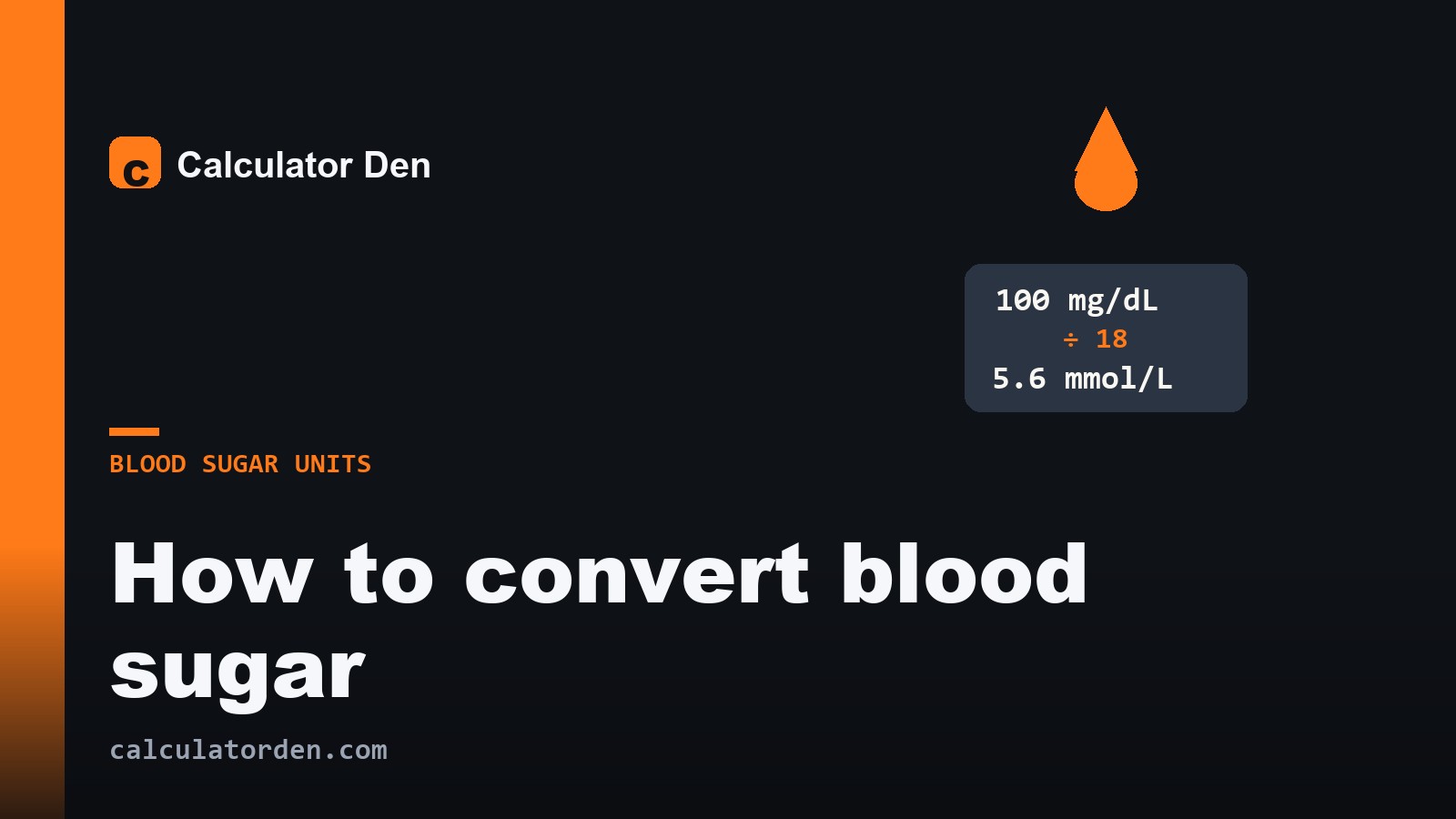
mmol/L = mg/dL ÷ 18, and mg/dL = mmol/L × 18.
The exact factor is 18.0182, but 18 is close enough for everyday use. Two worked examples: a reading of 100 mg/dL is 100 ÷ 18 = about 5.6 mmol/L. A reading of 7 mmol/L is 7 × 18 = about 126 mg/dL. If you only ever remember one thing, remember to divide mg/dL by 18 to get the smaller mmol/L number, and multiply the other way.
A quick conversion reference
These are the values that come up most often, rounded to one decimal place. Meters and labs may round differently, so a converted number can be a touch off: 5.6 × 18 is 100.8, not exactly 100.
| mg/dL | mmol/L |
|---|---|
| 70 | 3.9 |
| 90 | 5.0 |
| 100 | 5.6 |
| 126 | 7.0 |
| 140 | 7.8 |
| 180 | 10.0 |
| 200 | 11.1 |
What the numbers commonly mean
Thresholds vary by country and guideline, and your personal targets may be different, so treat the following as a general reference and not a diagnosis. Using widely cited thresholds such as those from the American Diabetes Association, a fasting reading under 100 mg/dL (5.6 mmol/L) is typically considered normal, 100 to 125 mg/dL (5.6 to 6.9 mmol/L) sits in the prediabetes range, and 126 mg/dL (7.0 mmol/L) or above on repeat testing points toward diabetes. Other bodies set slightly different cut-offs, so the exact lines depend on which guideline your clinician uses, and the 126 mg/dL mark needs confirming with a repeat test or an A1c, not a single reading. Readings after a meal naturally run higher, which is why a single number out of context says little.
This is exactly why units matter so much: mistaking a 7.0 mmol/L reading for 7.0 mg/dL, or a 126 mg/dL reading for 126 mmol/L, turns a borderline fasting result into either a dangerous-looking or a meaningless one. Always check which unit a number is in before you react to it. A reading around 70 mg/dL (3.9 mmol/L) or below is a widely used low-glucose alert level, and a very low or very high reading, or any worrying symptoms, means contacting a clinician or emergency services, not reaching for a converter. Take any concerning reading to a healthcare professional rather than acting on a conversion alone.
Blood sugar and A1c (HbA1c)
There is a third number you will meet: A1c (also written HbA1c), a percentage that reflects your average blood sugar over the past two to three months rather than a single moment. You can estimate the average glucose an A1c corresponds to, called the estimated average glucose or eAG, with a formula:
eAG (mg/dL) = 28.7 × A1c − 46.7, then divide by 18 for mmol/L.
For example, an A1c of 7 percent works out to 28.7 × 7 − 46.7 = about 154 mg/dL, which is about 8.6 mmol/L. That is an average, not a spot reading, so your meter will show numbers above and below it through the day. The eAG is an estimate, and your own average can differ from it; A1c can also read falsely high or low with conditions such as anaemia, some haemoglobin variants, pregnancy or kidney disease, which is why a clinician interprets it. A1c is sometimes given in a third unit, mmol/mol (the IFCC scale), which is not the same as mmol/L: a 7 percent A1c is about 53 mmol/mol. Our A1c calculator does this conversion for you, and the blood sugar converter switches a single reading between units.
Common conversion mistakes
- Mixing up the units. A number without its unit is meaningless. 5.6 and 100 can be the same reading; 5.6 mg/dL and 5.6 mmol/L are wildly different. Always carry the unit with the number.
- Comparing readings taken at different times. Fasting, before a meal and two hours after a meal all have different normal ranges, so converting units does not make two readings comparable if they were taken in different states.
- Treating eAG like a single reading. The average glucose from an A1c is a long-term average, not what your meter should show right now.
- Acting on a converted number alone. A conversion tells you the same value in another unit, nothing more. What a reading means for you is a conversation with your clinician.
Divide by 18 to go from mg/dL to mmol/L, multiply by 18 to go back, and keep the unit attached to every number, and the two scales stop being confusing. When you want it done instantly, the free blood sugar converter switches any reading between mg/dL and mmol/L, and the A1c calculator turns an A1c into an estimated average in both units. This article is general information, not medical advice; discuss your readings and targets with your doctor or diabetes team.
Frequently asked questions
How do I convert mg/dL to mmol/L?
Divide the mg/dL value by 18. For example, 100 mg/dL is about 5.6 mmol/L. To go the other way, multiply the mmol/L value by 18, so 7 mmol/L is about 126 mg/dL. The exact factor is 18.0182, but 18 is close enough for everyday use.
Which blood sugar unit does my country use?
The United States, Germany and some others use mg/dL. The UK, Canada, Australia and much of the rest of the world use mmol/L. They measure the same thing on different scales, so always note which unit a reading is in before comparing it to another.
How does A1c relate to blood sugar?
A1c is a percentage reflecting your average blood sugar over two to three months. You can estimate the average glucose it corresponds to with eAG = 28.7 times A1c minus 46.7 in mg/dL, then divide by 18 for mmol/L. An A1c of 7 percent is about 154 mg/dL or 8.6 mmol/L.
Can I diagnose diabetes from a converted reading?
No. Converting units only restates the same value on another scale. Diagnosis depends on how and when a reading was taken, repeat testing and a clinician's judgement. Take any concerning reading to a healthcare professional rather than acting on a conversion alone.