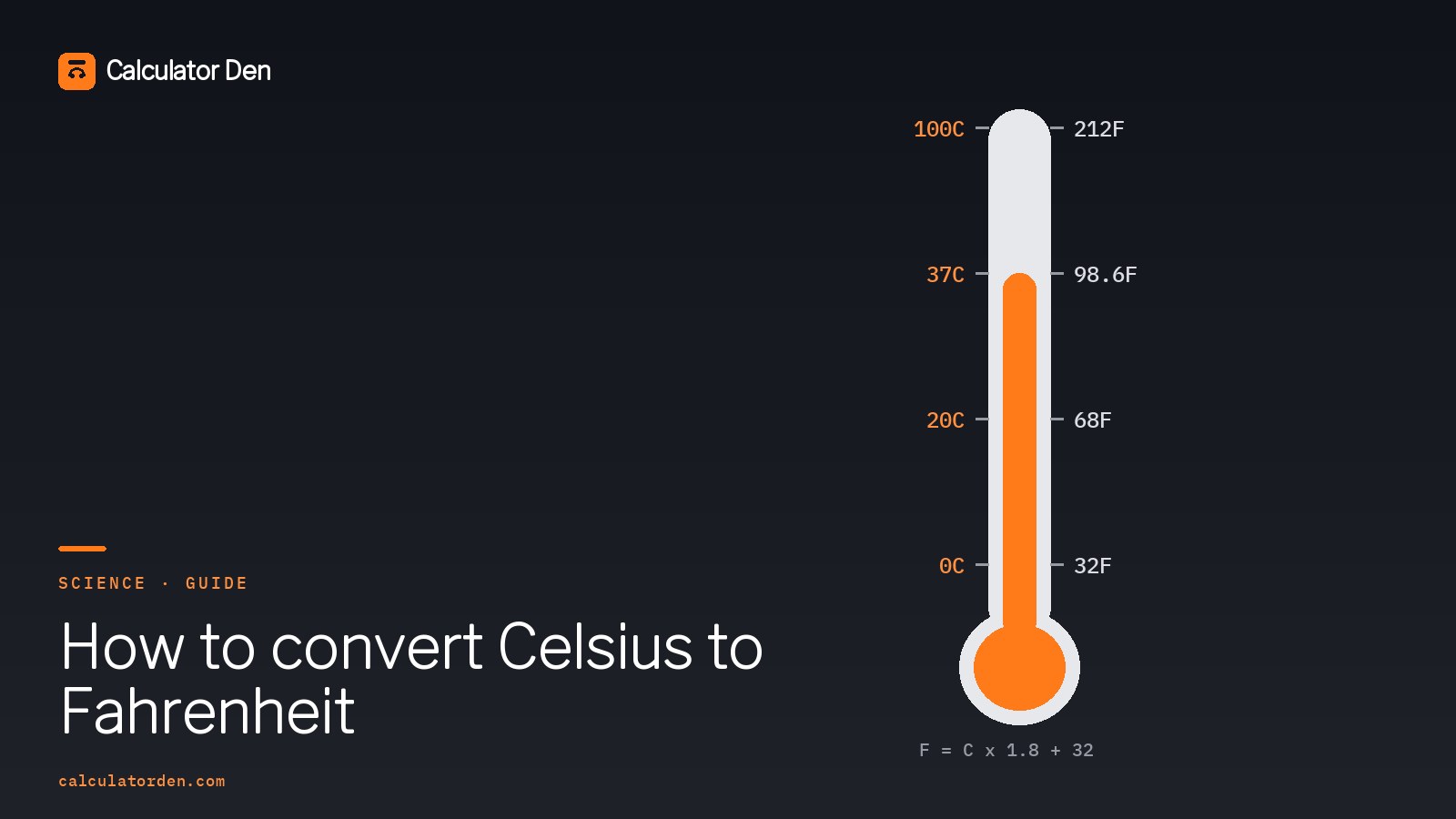
How to convert Celsius to Fahrenheit
The exact formula takes one multiplication and one addition, and there is a mental shortcut for everyday temperatures. Here is both, plus a chart and the one temperature where the two scales agree.
Convert a temperature between Celsius, Fahrenheit and Kelvin.
Converting Celsius to Fahrenheit comes up constantly: reading an overseas weather forecast, following a recipe, checking a fever, or just settling what "30 degrees" actually feels like. The exact conversion is a single short formula, and there is a handy mental trick for everyday temperatures. Here is how to do both, the reverse conversion, a chart you can keep, and a couple of facts that make it stick. A free temperature converter does it instantly.
In short: to convert Celsius to Fahrenheit, multiply by 9/5 (that is 1.8) and add 32. So F = C x 1.8 + 32. To go back, subtract 32 and multiply by 5/9.
The exact formula
The Fahrenheit value equals the Celsius value times nine-fifths, plus thirty-two:
F = (C x 9/5) + 32, which is the same as F = C x 1.8 + 32.
A worked example: to convert 20 degrees Celsius, multiply 20 x 1.8 = 36, then add 32 to get 68 degrees Fahrenheit. Another: body temperature of 37 C is 37 x 1.8 = 66.6, plus 32 = 98.6 F, the familiar number. The two steps are always the same: stretch by 1.8, then shift by 32.
Why 1.8 and 32?
The two numbers each do one job. The 32 lines up the freezing point of water: 0 C and 32 F are the same temperature. The 1.8 accounts for the different size of a degree: there are 100 Celsius degrees between freezing and boiling water, but 180 Fahrenheit degrees over the same range (32 F to 212 F), and 180 / 100 = 1.8. So every 1 C change equals a 1.8 F change. Understanding that is more useful than memorising it.
The quick mental trick
When you just need a rough everyday answer, skip the 1.8 and use this: double the Celsius and add 30. For 20 C, that is 20 x 2 + 30 = 70 F (the exact answer is 68, close enough to dress for the weather). For 25 C, it gives 80 F (exact 77). It works because doubling is close to multiplying by 1.8, and 30 is close to 32.
The catch: this shortcut drifts as temperatures get more extreme, because you are rounding 1.8 up to 2 and 32 down to 30. For 100 C it gives 230 (actual 212), which is well off. So use "double and add 30" for comfortable air temperatures (say 0 to 35 C) and the exact formula for anything precise, like cooking or medicine.
Want an answer that is exactly right in your head? Double the Celsius, take off 10 percent of that doubled number, then add 32. For 25 C: double is 50, minus 10 percent (5) is 45, plus 32 is 77 F, spot on. It works because doubling and then removing a tenth is the same as multiplying by 1.8.
A Celsius to Fahrenheit chart
| Celsius | Fahrenheit | Feels like |
|---|---|---|
| 0 C | 32 F | Water freezes |
| 10 C | 50 F | Chilly, jacket weather |
| 20 C | 68 F | Mild, comfortable |
| 25 C | 77 F | Warm |
| 30 C | 86 F | Hot |
| 37 C | 98.6 F | Body temperature |
| 40 C | 104 F | Very hot (or a high fever) |
| 100 C | 212 F | Water boils |
Fahrenheit back to Celsius
To reverse it, undo the two steps in reverse order: subtract 32, then multiply by 5/9 (that is divide by 1.8). So C = (F minus 32) x 5/9. For example, 98.6 F minus 32 = 66.6, times 5/9 = 37 C. The rough mental version is subtract 30 and halve it: for 68 F that gives 19 C (close to the real 20). It drifts at the extremes, though, 98.6 F gives 34.3 by that trick when the real answer is 37 C, so use the exact formula for anything precise.
Negative temperatures
Below-freezing temperatures use exactly the same formula, you just have to mind the minus sign. For minus 10 C: minus 10 x 1.8 = minus 18, then plus 32 = 14 F. For minus 20 C: minus 20 x 1.8 = minus 36, plus 32 = minus 4 F. Do the multiplication (including its sign) first, then add 32, and negatives behave themselves.
The conversions people actually need
Two everyday cases are worth memorising. Oven temperatures: 180 C is 356 F, 200 C is 392 F, and 220 C is 428 F, which recipes usually round to 350, 400 and 425 F. Fever: a temperature of 38 C, the common fever threshold, is exactly 100.4 F, which is why that oddly specific number appears on thermometers and health advice.
The one temperature where they meet
Here is the fact that surprises people: Celsius and Fahrenheit read exactly the same at minus 40. That is, -40 C = -40 F. It is the single point where the two scales cross. To prove it, set F equal to C: 1.8C + 32 = C, subtract C from both sides to get 0.8C + 32 = 0, so 0.8C = -32 and C = -40. (Check: -40 x 1.8 = -72, plus 32 = -40.) It is a handy sanity check that you have the formula the right way round.
And Kelvin?
Scientists often use Kelvin, which is the Celsius scale shifted so that 0 K is absolute zero, the coldest possible temperature (that is minus 273.15 C, or minus 459.67 F). The conversion is simple: K = C + 273.15. So 0 C is 273.15 K and 100 C is 373.15 K. One kelvin is exactly the same size as one degree Celsius, which is why you only add, you do not stretch. To go from Kelvin straight to Fahrenheit, convert to Celsius first: F = (K minus 273.15) x 1.8 + 32. Our temperature converter handles Celsius, Fahrenheit and Kelvin in one place.